Saturday, March 9, 2013

JFK and the Road to Dallas: Laos…The “Vietnam” That Never Was…by Mark Arnold


Note: In this installment, the eighth in the series on the causes of the decline of the United States as a nation, we explore President John F. Kennedy’s handling of the crisis in Laos from the Bay of Pigs debacle in April of 1961 to the Geneva “Declaration on the Neutrality of Laos” in July of 1962. It is important to keep several things in mind as you read this. First, our premise at the outset of the series was that JFK’s assassination represented a huge turning point for the United States as a nation; a shift away from the policies of peaceful co-existence and ending the Cold War that Kennedy was pursuing, and toward a policy of confrontation and war as planned by the CIA and its Secret Team of intelligence, military and corporate alliances otherwise known as the “military industrial complex”. Second, keep in mind the real question to be answered regarding Kennedy’s assassination is not if there was a conspiracy involved; the real question is why was he killed? It is the answer to this question that we are illuminating with this part of our series and particularly in describing Kennedy’s handling of Laos. Through his actions JFK prevented Laos from becoming our first “Vietnam” in Southeast Asia; instead causing it to become the “Vietnam” that never was…MA

        
  F
ollowing the Bay of Pigs, in late April 1961, a wiser and less naïve John F. Kennedy refocused his attention on the crisis in Laos. He had just successfully resisted his top military and CIA advisors in refusing to send U.S. forces to salvage the CIA’s Cuban brigade and now the same men who had misled him about Cuba were telling him that unless the United States intervened militarily in Laos that country would be lost to the communists. By the end of April the Joint Chiefs of Staff was recommending that JFK commit 140,000 troops to salvage the situation in the small Southeast Asian country.

          With the Bay of Pigs debacle fresh in his mind, Kennedy was understandably suspicious. On April 28th, in a meeting with the Chiefs, he asked them pointed questions about the data they were presenting him, exposing holes in their logic and conclusions. The Chief of Staff of the United States Navy, Admiral Arleigh Burke told Kennedy that at some point in Southeast Asia the U.S. would need to “…throw enough in to win…the works.” Army general George Decker agreed with Burke but went even further. Decker said, “If we go in, we should go in to win, and that means bombing Hanoi, China and maybe even using nuclear weapons.” At another meeting Joint Chiefs of Staff Chairman General Lyman Lemnitzer echoed Decker in stating, “If we are given the right to use nuclear weapons, we can guarantee victory.” When Lemnitzer made that statement JFK said nothing and just looked at him. Then he ended the meeting. His trust in the advice of his top military advisors was shot. To his aide Arthur Schlesinger he stated, “If it hadn’t been for Cuba, we might be about to intervene in Laos…I might have taken this advice seriously.”

General Lyman Lemnitzer
          On May 11th, 1961 the Russians, the Americans and 12 other nations met in Geneva, Switzerland on the subject of Laos while the civil war was raging in that small country. This was the international conference Kennedy had called for in March. As noted in an earlier article (please see “The Crisis in Laos”, the 6th installment of the series) Kennedy had already come out for a neutralist government in Laos free from the domination of foreign nations. This decision placed him at direct odds with the CIA which had assisted General Phoumi Nosavan in overthrowing the neutralist government of Prince Souvanna Phouma sometime earlier and were still assisting Nosavan at the time the Geneva Convention on Laos took place. It was the coup against Phouma which had sparked the latest round of civil war in Laos with Phouma and his half brother Prince Souphanouvong of the communist Pathet Lao allied against General Nosavan’s forces assisted by the CIA.

          Against this backdrop of Laotian civil war and the ongoing meetings in Geneva, JFK and Soviet Premier Nikita Khrushchev prepared for a summit meeting in Vienna, to be held on June 3rd and 4th, 1961. At the summit Kennedy had to push Khrushchev to get him to agree on the subject of a neutral government for Laos. Khrushchev pointed out that Kennedy well knew that “…it had been the U.S. government that had overthrown Souvanna Phouma”, in Laos. (You will recall that Phouma’s government was already neutral) To this Kennedy responded by saying “Speaking frankly, U.S. policy in that region has not always been wise.” He then reiterated that the desire of the U.S now was for a neutral and independent Laos. The irony of JFK’s position not lost on him, Khrushchev pointed out that Kennedy had “…stated the Soviet policy and called it your own.” JFK’s cold warrior critics in his own government certainly would have agreed with that assessment and were not happy about it. Nevertheless, having finally established a point of agreement with the Soviets that Laos should be neutral and independent, Kennedy contacted Averell Harriman, the U.S. representative at the Geneva talks, and told him flatly, “…I want a negotiated settlement in Laos. I don’t want to put troops in.”  Twice in the space of three months, first at the Bay of Pigs and now with Laos, Kennedy had taken actions directly counter to those his national security establishment was trying to manipulate him in to.
Kennedy and Khrushchev at Vienna 
                                                                                               
          The immediate effect of JFK’s Laos neutrality strategy on the military and intelligence people surrounding him was twofold. First, it deepened the schism that already existed between them and the President as a result of Kennedy’s handling of the Bay of Pigs. Second, it caused them to start to shift their focus and attention to Laos’s neighbor to the east, the divided nation of Vietnam. Though the CIA would continue to support, train and equip General Phoumi Nosavan and the military would continue to supply him with advisors, it was beginning to look like Kennedy would never allow Laos to become the major Cold War confrontation the Agency and Pentagon wanted it to be. From their view, due to Kennedy’s neutralist commitment, Laos was on the way to being a lost cause.

          Vietnam was another matter however. Unlike Laos, which pre-existed U.S. involvement there, South Vietnam and its President Ngo Dinh Diem existed and were in power solely because of CIA and therefore U.S. support. Diem assumed the Presidency of South Vietnam in 1955 with much assistance from Ed Lansdale and the CIA. The 1956 election called for by the Geneva accords of 1954, when the country was temporarily divided along the 17th parallel, never could have been ignored by Diem without this CIA/US support; the superior forces of the Vietminh simply would have come south, overrun the country and Vietnam would be united. Because Diem’s administration relied so much on U.S. support, he was quite taken aback by JFK’s neutralist strategy in Laos and he considered it a threat to his government. What if Kennedy should decide he wanted a neutral South Vietnam?

          In an effort to reassure Diem, Kennedy sent Vice President Lyndon Johnson to South Vietnam in May of 1961. On the same trip Johnson visited a number of other Asian allies such as Nationalist China (Taiwan), Thailand and Pakistan. His report to Kennedy following the trip presented a bleak picture of the ripple effect of Kennedy’s neutral policy on Laos; the regimes of these other nations, according to Johnson, were feeling the same way Diem was in South Vietnam. In closing his report to the President, Johnson summed things up this way:

          “The fundamental decision required of the United States—and time is of the greatest importance—is whether we are to attempt to meet the challenge of Communist expansion now in Southeast Asia by a major effort in support of the forces of freedom in the area or throw in the towel.”

Lyndon Johnson
Kennedy’s neutral stance on Laos and his refusal to commit to anything more than CIA and military advisor support to Laos and South Vietnam was being challenged not just by his intelligence and military chiefs but by his own Vice President.

          Despite the pressure from his own government, in Kennedy’s mind he and Khrushchev had resolved the Laotian crisis when they agreed at the June summit on the idea of a neutral Laos. In reality significant problems remained, however. Throughout the summer and into the fall of 1961 the negotiations between the various parties in Geneva dragged on and by August these problems were becoming clearer to the President. First, the Pathet Lao continued to control things in much of Laos militarily and were posing a real threat to just win the civil war outright over the CIA backed Phoumi Nosavan’s forces, which would have obviated the need for continued negotiations toward a neutral Laos. The second problem was that the insurgency in South Vietnam was increasing and guerilla attacks becoming more frequent. A supply and transport route had developed from North Vietnam through eastern Laos to South Vietnam by which men and equipment were being transferred to the guerillas in the south. This route was what would become known as the “Ho Chi Minh Trail”. The use of this trail by North Vietnam was becoming a sticking point in the Laos negotiations. In addition the CIA and Joint Chiefs were now demanding JFK send regular military troops into Vietnam to quell the increasing uprisings there as well as continuing to demand troops for Laos to support Nosavan so as to prevent what looked to be likely victory for the Pathet Lao.

Hi Chi Minh Trail
          Once again between a rock and the proverbial hard place, JFK was looking at difficult options no matter which direction he turned. Keep in mind the fact that Kennedy, like almost all American politicians of the day, had long since bought the central premise of the Cold War, that it was a battle between the forces of freedom, represented by the U.S., and the monolithic communist threat. In late summer of ’61 he had not yet rejected that premise and so found himself walking a very thin line. Having observed the French and not wanting that fate for his country he was opposed to committing regular U.S. military beyond equipment and advisors, yet faced with the threat of losing Laos outright to the communists as well as potentially Vietnam, he felt he had to do something. Kennedy responded to this dilemma at the end of August by backtracking a bit on his “neutral Laos” commitment and raising the total of advisors approved for Laos to 500 while authorizing the CIA to train and equip 2,000 more members of the “Hmong” (pronounced “moong’) tribe to assist in the fight against the communists. (The “Hmongs” were an indigenous people from the Laotian highlands. Nine thousand of the tribe were already involved in the CIA’s covert army and the addition now made eleven thousand; eventually the number would reach 30,000)

          Finally, in October 1961, there was at last a breakthrough in Geneva when the major Laotian factions represented there agreed to the concept of a neutral, provisional government with Souvanna Phouma as its prime minister. The language of the agreement also stipulated that Laos could not be used by neighboring states for their purposes, which meant that North Vietnam would not be able to use the “Ho Chi Minh Trail” as they had been. The Soviet Union agreed to take on the role of policing the compliance of the communist groups and nations at the conference to the agreement. The hopeful aspect of this accord to Kennedy was soon compromised by other factors that arose, however. The Soviets really had no power over North Vietnam or the Pathet Lao and had no way, really, of enforcing their compliance. Also, the communist nations insisted on the right to approve the movements of the International Control Commission in inspecting compliance to the agreement. (The International Control Commission was set up as an independent group with 3 members, 1 from communist Poland, 1 from anti-communist Canada and 1 from neutral India as an additional means of inspecting and enforcing compliance) The Russians, North Vietnamese and Pathet Lao would not compromise on this point and in the final agreement this effectively eliminated the ICC as any kind of policing agency.

Averell Harriman
          Due to the intractability of the communist nations Kennedy authorized Harriman to compromise on the ICC point and the negotiations moved forward. It would be another 8 months before, on July 23rd 1962 the United States, the Soviet Union and 12 other nations all signed the “Declaration on the Neutrality of Laos” in Geneva, Switzerland. Across those eight months the CIA with their support of Phoumi Nosavan and their “covert” Hmong army did their best to ensure that the fragile negotiations would never result in an agreement. In early 1962 Nosavan tried to provoke an international incident with the Pathet Lao by reinforcing a garrison called “Nam Tha” that was only 15 miles from the Chinese border and very close to Pathet Lao held territory. He then tried to provoke an attack from the Pathet Lao which, while succeeding in causing a few firefights, did not result in the hoped for attack. Nevertheless the CIA and Nosavan, pulling an old page from Ed Lansdale’s CIA playbook, staged a retreat from Nam Tha across the Mekong River into Thailand, claiming they were under Pathet Lao attack; an attack which did not, in fact, really exist. Their intention was to once again try and force JFK’s hand in sending troops to Laos to counter the Pathet Lao threat and thus destroy the negotiations.

          The machinations of the CIA and Nosavan with regard to the Nam Tha ploy were apparently an open secret to much of the rest of the world. The Times of London reported on the situation as follows: 

“CIA agents had deliberately opposed the official American objective of trying to establish a neutral government, had encouraged Phoumi in his reinforcement of Nam Tha, and had negatived the heavy financial pressure brought by the Kennedy administration upon Phoumi by subventions from its own budget…The General apparently was quite outspoken, and made it known that he could disregard the American embassy and the military advisory group because he was in communication with other American agencies.”

With the report from the Times as well as his own reports Kennedy must have understood what the CIA was up to in Laos. Though he responded to the pressure brought about from the Nam Tha incident by stationing American troops in the neighboring country of Thailand and having contingency plans drawn up to intervene in Laos should it become necessary, he once again stopped short of committing American troops to the civil war torn nation. His true understanding of what occurred at Nam Tha was indicated by another action he took on the matter; the transferring of the closest CIA officer to Phoumi Nosavan, a man named Jack Hazey.

       From the beginning of his administration through to the Geneva neutrality declaration on Laos in July of ’62, JFK had negotiated a minefield largely laid for him by his own CIA with complicity from his own military men designed to force him to intervene in Laos with regular U.S. forces. Through the actions he took he side stepped them every step of the way, thus ensuring that Laos did not become the quagmire that Vietnam came to be, and instead became, for the United States, the “Vietnam” that never was

           Knowing all this now, one is compelled to wonder…what would have happened in Vietnam had John F. Kennedy lived?

To be continued…

Copyright © 2013
By Mark Arnold
All Rights Reserved

Friday, March 1, 2013

JFK and the Road to Dallas: The Hidden Story of the Bay of Pigs…by Mark Arnold


Map of Cuba showing location
of the Bay of Pigs
Note: Suppose you were a newly elected President and during your transitional briefings you were told by the outgoing President and your intelligence and national security agencies of an operation that had been in the making for a year. The operation involved thousands of anti- Castro Cubans being trained and equipped to invade Cuba and re-take it from Castro, who himself had led a revolt a couple years earlier successfully overthrowing the corrupt, U.S. supported dictator Batista and setting up his own communist style regime on the island 90 miles from the coast of Florida. You are being told that the operation, despite its size, is a covert one that can be plausibly denied by the United States. You are also told that its chances for success are very high and that when the Cuban people see a successful rebellion starting against Castro they will rise up against him as well. You are as opposed to communism as the men briefing you but you are also aware that in supporting this operation the United States is technically violating international law and should regular U.S. military become involved you for sure are. You also know it violates other U.S. laws and rules. Nevertheless, the greater good prevails, and you go along with it and when the time comes to approve the tactical plan for the “covert” invasion to take place you do so, with the repeated stipulation no regular U.S. military be involved. Then the reports start coming in. Something has gone horribly wrong. The invading brigade is trapped on the beaches of Cuba and being cut to pieces. Your intelligence and military people are suddenly telling you that you must intervene NOW with the U.S. military or the invasion will fail. The choice presented is to violate law, both domestic and international, and the sovereignty of another nation even worse than you already are, knowing full well the duty of the Executive branch of U.S. government is to enforce the law, or to become known as the President responsible for the worst cold war disaster in the nation’s history. Those are your options…what do you do?

          In this blog I am presenting the hidden story of the disaster at the Bay of Pigs, the ramifications of which are still felt today. To help you here are the meanings to a few terms used in the article: “Operation Zapata” was the CIA’s code name for the Bay of Pigs operation. The “B-26” airplane was a twin engine, intermediate range bomber used in WW II. The Defense Dept OK’d the use of a number of these planes by the CIA for this operation. “Sterilized” simply means the equipment, in this case the B-26es, had all their identifying markings and serial numbers removed to ensure plausible deniability for the U.S. The “T-33” was a jet fighter built by Lockheed in the late 1940s. At the time of the Bay of Pigs Castro’s air force consisted of 10 T-33s, 7 of which were destroyed on the ground by the CIA B-26es in a pre-invasion attack on April 15. At the time of the invasion two days later Castro had three T-33s left. Now... to the hidden story of Operation Zapata and why the CIA's Cuban brigade failed...MA


  A
The B-26 bomber
T about 1:00 AM on Monday, April 17th, 1961 a Colonel in the U.S. Air Force was sleeping at his home in Virginia when he was awakened by a phone call. Over the sound of running airplane engines on the other end of the line the Colonel recognized the voice; an old friend was calling from Nicaragua. The friend was very upset. He told the Colonel that the dawn airstrike that was to have been launched to support the 1400 strong anti-Castro Cuban brigade about to hit the beaches at the Bay of Pigs had been delayed. An order had been received to hold the planes. He went on to tell the Colonel that anything later than a 2 AM departure by the sterilized B-26es carrying out the strike would mean they would not be able to arrive by dawn when the brigade’s beach assault was scheduled. As a result Castro’s remaining air force of 3 ancient T-33s would not be destroyed on the ground as per the plan approved by President Kennedy on April 16th when he gave final authorization for the assault. The T-33s would be alerted when the brigade landed, would be free to take off unopposed and would attack the brigade and its supply ships from the air.
T-33 Jet Fighter

          The friend on the phone with the Colonel was the CIA commander at Puerto Cabezas, Nicaragua, where the sterilized B-26es were based. He urged the Colonel to call General Charles Cabell, the CIA’s Deputy Director, at the Operation Zapata office and demand the immediate release of the B-26es.The CIA commander told the Colonel that the Cubans piloting the B-26es were so eager to depart that they would leave without orders to do so if the commander just got on his bike and disappeared for a few minutes. Later both the commander and the Colonel wished he had done just that.
                                                                                                       
General Cabell
          Hanging up the phone the Colonel looked at his watch. There was less than an hour until 2 AM. He called General Cabell but was unable to reach him. Cabell’s senior, CIA Director Allen Dulles was out of the country and also unreachable. The Colonel, knowing that Kennedy had approved the airstrikes as a vital part of the plan, then called the Zapata office again and suggested that the B-26es be released on Kennedy’s orders. He was told that the situation was being run by the President’s Special Assistant for National Security Affairs, McGeorge Bundy, Deputy Director CIA Charles Cabell and Secretary of State Dean Rusk. The Colonel knew that unless the B-26es were allowed to leave very soon the anti-Castro brigade would be defeated and the entire plan would fail. Yet he could find no one willing to make the phone call to his friend to authorize the release of the planes, even though it was exactly per Kennedy’s wishes that it be done. As a result the 3 antiquated jets of Castro’s air force controlled the skies over the brigade’s landing zone, sank the brigade’s supply ships, raked the brigade on the beach with gunfire and shot down 16 B-26es that did finally arrive late on the scene. The B-26 was no match for a T-33 in the air.

Navy Admiral
Arleigh Burke
          As it was becoming obvious that the CIA’s Cuban brigade was failing in its objectives, the CIA and the Joint Chiefs of Staff prevailed on Kennedy to intervene with U.S. military support to save it. In an emergency meeting called just before midnight on April 17th Kennedy, along with Vice President Lyndon Johnson, Secretary of State Dean Rusk and Secretary of Defense Robert McNamara met with Joint Chiefs of Staff Chairman Lyman Lemnitzer, The Chief of Staff of the Navy Arleigh Burke and The CIA’s Richard Bissell. The CIA and military people requested the meeting to pressure JFK to authorize the use of U.S. Navy jets and a destroyer to help the brigade overcome Castro’s forces. Bissel made an impassioned plea to the President for assistance from the military. Kennedy reminded them that all along he had stated he would not use regular U.S. military in such operations. The meeting became heated with Burke becoming angry. Kennedy, however, still held his ground.

          The CIA and the Chiefs had JFK between a rock and a very hard place; he either authorized the use of the military to save the operation or the brigade would fail and he would appear to be responsible for the worst U.S. Cold War disaster to that point in time. They thought Kennedy would go along. They were wrong. Kennedy knew that the use of the U.S. military to invade another nation with whom we were not at war violated international law. He also knew that the CIA was already in violation of its founding law, the National Security Act, by engaging in paramilitary operations in the first place and that earlier National Security Council directives forbade the use of regular U.S. military forces for such operations in peacetime. Because of these things, and probably because he sensed he was being trapped into this escalation, Kennedy refused to authorize U.S. military intervention to save the Cuban brigade. Two days later some 1100 of the CIA’s brigade surrendered to Castro’s forces and the disaster that was the Bay of Pigs became President John Kennedy’s first experience at trusting the CIA. It was a lesson he would never forget.
                                                                                                           
L. Fletcher Prouty
          The Colonel who took the phone call from the CIA officer in Nicaragua and tried in vain to find a responsible party to release the B-26es was none other than L. Fletcher Prouty. He is the author of two books that lay open how the CIA operates as well as expose much of its history in covert operations. The books are “The Secret Team: The CIA and its Allies in Control of the United States and the World” and “JFK: The CIA, Vietnam and the Plot to Assassinate John F. Kennedy”. For 9 years, from 1954 to 1963, Prouty served as Focal Point officer for contacts between the CIA and the Department of Defense on matters pertaining to military support for the CIA’s Special Operations. (“Special Operations” is a CIA euphemism for its covert and often paramilitary operations, such as the Bay of Pigs invasion) His job as Focal Point officer included briefing people such as the Secretary of Defense and the Chairman of the Joint Chiefs of Staff as well as other Defense Dept officials on the money, materiel and military requirements for the various CIA operations planned around the world in order to gain their support for the Agency’s operations. Though he represented the CIA in these briefings, Prouty was not CIA himself, but a career Air Force pilot and officer. As such he never took the Agency security oath. During these years Prouty’s duties took him to over 60 nations, as well as CIA stations and covert operations the world over. Because of the post he held Prouty’s knowledge of the CIA, how it operates and what it did is extensive and he is uniquely qualified to report on circumstances such as the Bay of Pigs scenario described above. As in the Bay of Pigs operation, he often was present at and therefore observing what he describes in his books.

          Following the Bay of Pigs disaster, as Prouty reports in “JFK: The CIA, Vietnam and the Plot to Assassinate John F. Kennedy”, Kennedy took public responsibility for the failure of the CIA’s Cuban brigade. Privately, however, he felt he had been misled and lied to by the CIA. He had approved a plan calling for airstrikes to take out the weak Cuban air force on the ground but someone had delayed the strikes thus causing the failure of the mission. He then was heavily pressured to allow the use of regular military forces to salvage the CIA’s brigade, something he successfully resisted. It was almost as if the B-26es were deliberately delayed to force Kennedy’s hand in allowing the use of the regular military in the operation.

          To get to the bottom of what occurred, on April 22, 1961 Kennedy appointed a 4 person group to look into the matter. The group consisted of CIA Director Allen Dulles, Navy Chief of Staff Admiral Arleigh Burke, Army General Maxwell Taylor and JFK’s brother, Attorney General Robert Kennedy. Over the next seven weeks the group met, interviewing key witnesses and participants in operation Zapata. Every evening after the meetings Robert Kennedy would see his brother and report on the day’s findings. On June 13 General Taylor submitted the group’s findings to the President in the form of a long letter. It was following this report that JFK fired the Director and Deputy Director of the CIA, Allen Dulles and General Charles Cabell as well as the Deputy Director for Plans and the CIA official directly running Zapata, Richard Bissell. Shortly Kennedy followed that up with National Security Action Memorandum #55 to the Joint Chiefs of Staff which I described in an earlier blog. In NSAM #55 Kennedy told the Chiefs that he held them as responsible for advice during cold war operations as he would if the country were at war; a direct effort to depower the CIA of its covert operation capabilities. With all this understood, the pressures Kennedy was under and the threat he represented to the intelligence community and the war planners perhaps becomes a bit clearer. Kennedy did not fall for the trap during the Bay of Pigs and refused to use regular military to salvage the Cuban Brigade. But that didn’t mean that those opposing him in the military industrial complex and the secret team were through trying, as we shall see.

          There is one last peculiar aspect to the whole Bay of Pigs affair that bears mentioning. After the special group investigating the Bay of Pigs filed its report with the President as to the causes of the debacle, the report itself vanished and for many years its whereabouts was unknown. Many doubted the existence of the report in the first place. Then in 1979 an author named Peter Wyden published a book called “Bay of Pigs: The Untold Story”. In his book Wyden makes frequent mention of the special group’s report to the point where it was obvious that he had access to it in writing the book. Suddenly the long missing report had surfaced. Around the same time Wyden’s book was published Kennedy’s former Special Assistant McGeorge Bundy published an article on the op-ed page of the New York Times called “The Brigade’s My Fault”. Fletcher Prouty speculates that Bundy had obviously read Wyden’s book and now felt the need to cover his tracks. According to Prouty, who possessed one of the few copies of the “long thought missing” report, in paragraph 43 the report states:

“At about 9:30 PM on April 16, Mr. McGeorge Bundy, Special Assistant to the President, telephoned General Charles C. Cabell of CIA to inform him that the dawn air strikes of the following morning should not be launched until they could be conducted from a strip within the beachhead.”

McGeorge Bundy
It was Bundy who had placed the phone call delaying the air strikes that in turn had caused the failure of operation Zapata and 18 years after the fact the proof had surfaced in the form of the report. Obviously in using the word “Brigade” in the title of his article Bundy is referring to the CIA’s Bay of Pigs brigade. Yet the article he wrote for the New York Times, despite its title, says nothing about the Cuban brigade and instead deals with the Cuban Missile Crisis which took place a year and half later. Who knows what Bundy had in mind in writing such a confusing article but it certainly wasn’t to step up and be responsible for the failure of the Cuban brigade as the article’s title would seem to indicate.

          Also, the question of whether or not the CIA was planning all along on trying to force President Kennedy into allowing the use of U.S regular armed forces in operation Zapata was clarified with the discovery in 2005 of a CIA document dated November 15, 1960. The document states the conclusion that the invasion was “unachievable except as joint Agency/DOD action.” (DOD means Dept of Defense). The Agency was aware all along that the invasion by the Cuban brigade alone would likely fail and did their best to trap JFK into agreeing to use the regular military to ensure its success.

          They severely misestimated their man.

To be continued…

Copyright © 2013
By Mark Arnold
All Rights Reserved

Sunday, February 24, 2013

JFK and the Road to Dallas: The Crisis in Laos…by Mark Arnold


 Note: I was recently asked by a reader what evidence existed to demonstrate that if President Kennedy had lived the United States never would have become involved in the ground war in Vietnam, in effect preventing that war from happening beyond the level the CIA had  already escalated it to in 1963. She was wondering because she had heard that President Lyndon Johnson simply continued Kennedy's policies regarding Vietnam when he came to office. I am very glad that she brought this question up because it is a classic example of the effect of the revisionist histories that have been published of this time period. In the next few blogs of this series we will walk through the crises that JFK faced while in office and the reader will see for himself the pressures exerted upon him to force him to war and the measures he took to avoid it. You will also see for yourself the track of events that brought him to the conclusion that the way for the United States to move forward in the world  was through policies promoting peace. As Kennedy walked this track ever closer to that fateful day in Dallas, you will see the pressures building against him. The simple truth is that Kennedy's turn toward peace was at direct odds with those forces promoting and wanting the Vietnam War, and so when they assassinated him in Dallas in 1963, it was a major turning point for our nation and has drastically affected everything since. Understanding this, the real question becomes this: who benefits by promoting the revisionist view that Kennedy initiated the policies that resulted in the Vietnam War? Keep that question in mind as you read through this information....answers are forthcoming...MA


  O
JFK 
n January 19th, 1961, the day before he was to be inaugurated as President, John Kennedy was getting a transitional briefing from  outgoing President Dwight Eisenhower. One of the subjects they discussed was the Southeast Asian country of Laos. In 1961 Vietnam was not yet the major crisis it would become, but Laos very much was. The small country, just to the west of Vietnam, had also been a French colony prior to World War II and like Vietnam attempted to win its independence from France after the Japanese were defeated in 1945. Opposing the French in Laos was a group of communist rebels known as the Pathet Lao, (meaning simply Lao Nation) who had allied themselves with Hoh Chi Minh and the Viet Minh.

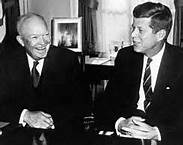
Eisenhower and Kennedy
          When the French lost at Dien Bien Phu in May of 1954 French rule ended in Indochina. The Geneva accords ending that conflict (known as the First Indochina War) temporarily divided Vietnam into northern and southern zones for a period of two years at which time national elections were to occur to determine how the country would be governed. (Though the U.S. did not sign the Geneva Accords it did pledge to honor them) The Geneva accords also granted Laos full sovereignty as a neutral nation. All the warring parties, the French, the Pathet Lao and the Vietnamese were to withdraw and allow the new Laotian government to form. The French did leave but with no way to enforce the Geneva agreements the Pathet Lao supported by the North Vietnamese stayed and remained in control of several provinces. Staying too was the CIA, working under the cover of something called the Programs Evaluation Office in late ’55 and early ‘56, which was supposed to be a civilian aid program, and later the Agency for International Development which had a similar false purpose. The CIA had been in Laos since 1953, initially in response to French requests for assistance with air transport for troops and materiel in their fight against the Pathet Lao and Viet Minh. (The CIA used its proprietary airline Civil Air Transport, later known as Air America, for this purpose in ’53 and ’54 and also to deliver the secret CIA operatives of the Saigon Military Mission to North Vietnam to wreak their havoc there.)

          Finally, after several efforts, out of the confusion in Laos emerged a coalition government in 1956 that had been negotiated by the neutral Prince Souvanna Phouma and his half-brother, Prince Souphanouvong of the Pathet Lao. As a result Phouma was made the Laotian Premier and Souphanouvong assumed a chief role in the cabinet. It was also agreed that the Pathet Lao would be merged into the government’s Royal Laotian Army and that their controlled provinces would be assimilated under the Phouma government.
Prince Souvanna Phouma

          For a while things became relatively calm. Then in 1958 national elections were held with the result that communists gained additional seats in the National Assembly. That was enough for the CIA which, under the guise of the Agency for International Development, proceeded to cut aid to and foment against the Phouma government, the ultimate result of which was the installation to power of the CIA backed and anti-communist general Phoumi Nosavan in 1960. The consequence of this was, of course, the return of full blown civil war to Laos with the Pathet Lao and the neutralist forces fighting those of the dictator Nousavan. That was more or less the situation at the time Eisenhower was briefing JFK in early ’61.                                                                              
Prince Souphanouvong

          God what a mess!
                                                                                                               
        In the transition briefing from Eisenhower, Kennedy asked the old general if he preferred to resolve the Laotian crisis by negotiating a new coalition government with the communist Pathet Lao or by intervening militarily with US troops. Shocked that Kennedy would even suggest something as outlandish as a coalition government with the communists, Eisenhower responded that intervening militarily would be the far better choice. On hearing Eisenhower’s words, Kennedy was skeptical but kept his own counsel. He realized that Eisenhower himself had avoided sending ground troops to Laos through the last 6 years of his administration and he also had the warning from Edmund Gullion 10 years earlier about what we could expect if we intervened with ground troops in Southeast Asia based on the French example. During the Cold War mentality of the times, however, John Kennedy’s view was in the distinct minority, as he would soon find out.

Phoumi Nosavan
         With the above in mind you can see that at the outset of JFK’s administration in 1961, though he was as anti-communist as anyone, the seeds of conflict with those who would become his closest advisors in military and intelligence matters, the top officials of the CIA and the Joint Chiefs of Staff, were already planted and well on their way to sprouting. The CIA already had in motion covert military operations in Laos. They already were in the process of training and equipping 30,000 Hmong (pronounced Moong) tribesman from the Laotian highlands for battle against the Pathet Lao and already were using Air America for supply drops and personnel transport. They already had a massive covert military operation planned for Cuba (the Bay of Pigs) and already were planning on the use of regular U.S military in these operations. Kennedy on the other hand, was committed to finding diplomatic or other solutions that would stop short of direct U.S. military involvement. He did not want his nation to go through what the French did in Indochina from 1946 to 1954 and he did not want to risk direct confrontation with the Soviet Union thus risking nuclear war. To understand Kennedy and his actions at this time it is important to understand these things.

Winthrop Brown
          Two weeks into his new administration, on February 3rd 1961, Kennedy had a meeting in Washington DC with the U.S. Ambassador to Laos, a man named Winthrop Brown. Kennedy asked Brown what he thought about the situation in Laos. Brown responded with the normal Cold War rhetoric he thought the Commander in Chief wanted to hear. Kennedy stopped him mid sentence. “That’s not what I asked you”, he said. “I said ‘What do you think, you, the Ambassador?” Stunned that JFK actually wanted to know the truth, Brown told him what he actually thought; that the only way Laos could be united again was under the neutralist Souvanna Phouma, whose government had been deposed by the CIA and General Nosavan the year before. Kennedy continued to question Brown thoroughly about the possibility of a coalition government under Souvanna that all parties, including the Soviet Union, North Vietnam and the Pathet Lao could support. Over the next several weeks he also questioned  his  military and intelligence advisers closely, picking apart their reasons for urging direct U.S. involvement. Ultimately this led to a March 23rd news conference on Laos in which Kennedy stated that the U.S. “strongly and unreservedly” supported a neutral and independent Laos tied to no outside power or group of powers and free from domination. He endorsed an appeal for a cease fire between the neutralist/Pathet Lao forces and the CIA backed General Nosavan’s army and, along with the British, called for an international conference on Laos.
                                                                                        
JFK at March 23rd Laos Press Conf
          Meantime the tide of battle in Laos was turning in favor of the communists and it looked as though the Nosavan government might fall before the conference Kennedy called for could even be convened in Geneva. The CIA and the Chairman of the Joint Chiefs of Staff, General Lyman Lemnitzer, used this fact to press Kennedy for direct U.S. military involvement in Laos; otherwise there may be nothing left to negotiate at Geneva when the time came. Kennedy saw the problem and for several weeks seriously considered what his CIA and military advisers wanted him to do. While he wanted a neutral Laos he was equally certain that he did not want a communist one and the results on the battlefields seemed to be making that a likely possibility. Then something happened that caused the crisis in Laos to be put on hold, at least for the time being. On April 17th, 1961 the CIA trained and equipped Cuban brigade landed on the Cuban beaches at the Bay of Pigs.

To be continued…

Copyright © 2013
By Mark Arnold
All Rights Reserved

Friday, February 22, 2013

A Turn From War: JFK and the Road to Dallas… by Mark Arnold


Note: During the nearly three years he was in office President John Kennedy underwent a remarkable metamorphosis. In his masterful book, “JFK and the Unspeakable: Why He Died and Why It Matters” author James Douglas does an expert job of chronicling the events Kennedy experienced and which precipitated this change. Of all the books I know of on the Kennedy years and his assassination Douglas’s book and L. Fletcher Prouty’s excellent “JFK: The CIA, Vietnam and the Plot to Assassinate John F. Kennedy” are the two best and most important. They both are meticulously researched and documented. Most of the material for this series of articles comes from these books and for the full story you must read them. It has been 50 years since these events have taken place. Revisionists have had their way with the histories of those times. Most young people I have talked to are woefully ignorant of the true facts of this history and in their computer and video game world are never likely to find out. Even most of those of my generation, who actually lived through these times, do not know the truth behind the influences that have shaped their lives and which in many ways shaped the nation we have today; a nation that is in serious  danger of losing forever our precious heritage of freedom. It is my hope that illuminating the truth will douse the mystery and put people into action in present time. If enough people are challenged fast enough there is still time to save the United States. MA

         
A
JFK
t the time of his election in 1960 John F. Kennedy was a committed Cold Warrior. In his January, 1961 inaugural address he acknowledged as much when he said: “…let every nation know, whether it wishes us well or ill, that we shall pay any price, bear any burden, meet any hardship, support any friend, oppose any foe to assure the survival and success of liberty.” In the bellicose, anti-communist days of the early ‘60s we all knew that comment was directed at the Soviet Union. JFK knew it too. Over the next two and a half years, however, Kennedy would make a sea change and in all likelihood would have brought about a sea change for the nation had he not been assassinated. Subtly at first, and then more markedly as his administration progressed through 1962 and into 1963, Kennedy made the turn toward a policy of peaceful co-existence with the Soviet Union and away from the “Report from Iron Mountain” idea that a nation’s war powers provided its governmental means of control over its population as well as its economic well being. (For information on “Report from Iron Mountain” please see my earlier blog in this series “Some Comments on War...”) It was this change and the promise that it held for changing the nation that got JFK killed. The military-intelligence-industrial complex and those above it pulling its strings would not allow the Kennedy sought change toward peace to occur.

          As discussed in earlier blogs in this series, John Kennedy’s presidential rocking chair was hardly warm when he was hit with the first major crisis of his administration; the CIA caused disaster at the Bay of Pigs in Cuba in April, 1961. (Due to a bad back JFK would often sit in a rocking chair.) As noted in those writings, though he took responsibility for the Bay of Pigs debacle publicly, privately he felt he had been lied to and misled by the CIA. The handlings he took to depower the CIA included firing the Director and Deputy Director (Allen Dulles and Charles Cabell) and the issuing of National Security Action Memorandum (NSAM) #55 to the Joint Chiefs of Staff in which he directed that they would be as responsible for advice to him in Cold War operations as in regular wartime operations, thus signaling to the CIA the intent to curtail their covert operation powers. In addition to these already noted actions he also fired Richard Bissell, who as Deputy Director for Plans ran the Bay of Pigs operation and was, for practical purposes, the number three man at the CIA. He also cut the CIA’s budget and issued orders to all the U.S. embassies around the world that he held the U.S. Ambassador to each nation responsible for the actions by all U.S. personnel in his zone. This effectively put the U.S. Ambassador to any country senior to any CIA personnel and operations within that country with power over them. Needless to say, the CIA did not like these efforts at control and as a result a major schism developed between the President and his intelligence community.

          Following the Bay of Pigs through to the end of 1962 Kennedy negotiated his way through an obstacle course of one crisis after another, starting first with the Southeast Asian country of Laos (situated just to the west of Vietnam), then Berlin and finally the Cuban Missile Crisis in October of 1962. Looming over all of these was the specter of Vietnam, which from 1954 on was being built up by the CIA and would ultimately become the next major armed conflict in the Cold War. Had Kennedy lived Vietnam never would have happened, and therein is the key to his assassination. Because of this fact his death was a major turning point for the nation, which can now be clearly seen in retrospect. To appreciate the magnitude of this turning point, ask yourself these questions:

“What if the Vietnam War had never happened? What if the 58,000 Americans who died there went on to live out their lives? What if, by some estimates, the nearly 2 million Vietnamese killed through the Vietnam War were never killed? What if the nearly $500 billion (in 1960s dollars) spent on the Vietnam War was never spent and what if the social upheaval in the United States that occurred in the late ‘60s and early ‘70s as a result of the war never took place?” 

Ask yourself these questions and try to envision the answers. Do so and you will start to have an appreciation of just what occurred in Dallas on November 22nd, 1963 when President Kennedy was killed. Revisionist historians have tried to obscure the truth, claiming that JFK is the President who got us into Vietnam. As we walk through the events leading to Kennedy’s murder in Dallas draw your own conclusions. 

          During the First Indochina War, in 1951, ten years before he was elected President and at the time a congressman, John F. Kennedy took a trip to Vietnam with his brother Robert. You will recall that after World War II the French were trying to re-assert their control over their former colony. They were being opposed in this effort by Hoh Chi Minh and his army, the Viet Minh, who were fighting for Vietnamese control of their homeland. During the trip Kennedy spoke to the French commander, who had over 250,000 troops at his disposal. The French commander told JFK that with this overwhelming force there was no way he could lose to the Viet Minh. On this trip Kennedy also spoke to a friend of his, a man named Edmund Gullion, who at the time was an official at the U.S. consulate. Gullion told Kennedy the exact opposite:

Edmund Gullion
“We’re going nowhere out here”, he said. “The French have lost. If we come in here and do the same thing, we will lose, too, for the same reason. There’s no will or support for this kind of war back in Paris. The home front is lost. The same thing would happen to us.”

Spoken 3 years before the devastating French defeat at the battle of Dien Bien Phu, Gullion’s words take on a kind of prophetic air. Kennedy never forgot them.

          This partially explains why, though at the beginning of his term he was as dedicated an anti-communist as any of his intelligence or military men, Kennedy would never commit U.S. ground troops to action in any of the crises he handled, despite the pressure brought from the CIA or the Joint Chiefs of Staff to do so. In addition he was acutely aware of the threat posed by a possible nuclear exchange with the Soviet Union and what this would mean for mankind. In September of 1961 he revealed this concern in an address to the United Nations when he stated:

“Today, every inhabitant of this planet must contemplate the day when this planet may no longer be habitable. Every man, woman and child lives under a nuclear sword of Damocles, hanging by the slenderest of threads, capable of being cut at any moment by accident, or miscalculation, or by madness. The weapons of war must be abolished before they abolish us.”

For these reasons, time and again when faced with a crisis, with his military and intelligence men demanding that he commit U.S. forces to action, Kennedy would find a way out and not do it. The pattern, as we shall see, is unmistakable. It manifested in the Bay of Pigs debacle when he refused to release U.S. forces to salvage the CIA’s battered brigade on the Cuban beaches and it would manifest several more times through the next two years. It was a pattern that would cost him his life.

To be continued…

Copyright © 2013
By Mark Arnold
All Rights Reserved

Sunday, February 17, 2013

Fox in the Henhouse: The Story of Allen Dulles…by Mark Arnold


  N
Allen Dulles
o study of the decline of the United States as a nation over the last half of the 20th century and on into the 21st century could possibly be complete without a grasp of the role played by Allen Dulles. His impact on the U.S. intelligence community in both World War II and the Cold War was immense and reverberates to this day. As Director of the CIA from 1953 to 1961, due to the expanded role of covert operations he took on for the Agency, often violating the sovereignty of other nations as well as international law and the National Security Act itself, he had a vast effect on American foreign policy. As a result much of the negative attitude of other nations towards the U.S. can be traced to him and the actions and policies he authorized for the CIA. As you will see, if you confront the information fully, his actions had a devastating effect on the nation domestically as well and include assistance in the cover up of the truth behind the assassination of John F. Kennedy, if not outright participation in the plot to kill the President. If ever there was a key figure to understand in the middle part of the 20th century in the United States, and a bona fide “fox in the henhouse”, it would be Allen Dulles.

          Born in 1893 and educated at Princeton University, Allen Dulles began his intelligence career rather humbly in 1916 when he was stationed as a diplomat in Bern, Switzerland collecting political data for the State Department on Germany and the Austro-Hungarian Empire during World War I. By the late 1920’s he was working with his older brother John Foster Dulles (who became Secretary of State under Dwight Eisenhower in the‘50s) as a lawyer and international finance specialist for Sullivan and Cromwell, a Wall Street law firm in New York. Across the 1930s he and his brother worked with top Nazi industrialists and played a major role in fostering U.S.-Nazi corporate relations. He was a legal counsel for Rockefeller’s Standard Oil, the infamous Nazi chemical giant I.G. Farben, (the producer of the poison gas used in the extermination of the Jews.) as well as banks and financial institutions established by German steel magnate and Nazi supporter August Thyssen. In 1933 both Dulles brothers attended a meeting with Adolph Hitler in Germany at which German industrialists pledged to support Hitler in exchange for Hitler’s promise to suppress the German labor unions. They encouraged their Western clients to contribute to the Nazi party and war machine and it would not be an exaggeration to say that the Dulles brothers by their actions significantly helped Hitler and the Nazis attain power and build up their war machine once they were in power. They had many communication lines into the Nazi regime.

          When the U.S. entered WWII, Dulles became the Bern (Switzerland) station chief for the wartime Office of Strategic Services. At one point none other than President Franklin Delano Roosevelt suspected Dulles of being a traitor due to his connections to Nazi linked corporations. After the war was over Dulles was instrumental in helping Nazi corporations that had used slave labor to produce Nazi war materials evade prosecution. He and his brother were also able to prevent the prosecution Nazis who were known mass killers and assisted in arranging their flight from Germany and Europe to the U.S. or South America. He helped the Nazi intelligence apparatus turn over its assets to the West specifically negotiating the surrender of Nazi General Reinhard Gelen, the top German spymaster dealing with Russia and the eastern front. Gelen brought with him his corp of 350 or so Nazi intelligence operatives and they all proceeded to go to work for the OSS and ultimately the CIA under Dulles. Gelen’s group was added to as other Nazi’s found their way to him and ultimately numbered as high as 4,000, being mostly former German army and SS officers.

          By the early 50s, when Dulles assumed the post of director of the CIA, he was well connected in the both the intelligence and international banking fields. Through the 1950’s under the Eisenhower Administration he shepherded the CIA away from merely an intelligence coordination office into a nearly autonomous covert operations force, beyond the control of the President, and the likes of which the country had never seen. That was the man running the CIA at the time Kennedy came into office.

          To give you some idea of how the CIA under Alan Dulles operated and interfered in the internal affairs of other nations we will take a look at an actual example; the Central American country of Guatemala in 1954. A leader named Jacobo Arbenz had won the Guatemalan presidential election of 1950. After establishing himself in office he started initiating land reforms in which land held by several U.S. corporations that had been ceded to them or sold to them by earlier Guatemalan dictators (to the dictator’s profit and to the loss of the Guatemalan people) was nationalized and made available for peasant use and ownership. The largest of these corporations was United Fruit Company, a former client of Dulles’s old law firm Sullivan and Cromwell. United Fruit owned something like 42% of the arable land in Guatemala and they weren’t going to take this loss lying down. They exerted pressure in Washington D.C. on the Truman and later the Eisenhower administrations which resulted in the full covert operations force of the CIA being called into operation against Arbenz. The CIA actions taken included a black propaganda campaign against Arbenz from a CIA secret radio station in southern Florida that would broadcast into Guatemala labeling Arbenz a Soviet puppet and a communist. In addition the CIA equipped and trained a 480 man rebel force under a disaffected Guatemalan right wing general for the purpose 
of staging a coup d' etat against the Arbenz government and also created hit lists of Arbenz sympathizers to be assassinated during the coup and the days immediately following. In order to avoid being killed Arbenz and his top advisors resigned their posts and fled the country. Guatemala, destabilized by CIA interference in their internal affairs, ended up in a prolonged civil war that lasted over 30 years and in which several hundred thousand Guatemalans died.

        The Guatemalan coup of 1954 is typical of CIA covert ops being run around the world during the Dulles tenure that were justified as fighting communism. Very few Americans at the time knew these actions and coups were taking place in their name and using their tax dollars; but they were taking place and these actions by the CIA did not endear the U.S. to the peoples of these countries, of that I can assure you. That the actions I refer to definitely involved the assassinations of heads of state by the CIA is made evident by documents from this Guatemala period being made available by Freedom of Information Act requests. One such document is a 19 page training manual on how to conduct political assassinations. One shudders to consider the use to which this manual was put during the Dulles era at CIA and in the decades following based on his example and the policies he set while running the Agency.
Fidel Castro ca.1960
                                                                                          
          By 1961, when JFK came into office, the CIA’s Vietnam operation was simmering but the Cuban operation was about to boil over. The invasion group of Cubans equipped by the CIA for the purpose of re-taking Cuba from Castro had been in training for some time. Part of the operation called for the assassination of Castro prior to the invasion and the CIA had partnered with none other than the Mafia in order to get it done; another great use of your tax dollars. However, none of the various schemes they concocted were effective and by mid April of 1961, immediately prior to the scheduled invasion, Castro was still in power. The CIA prevailed upon the new Kennedy administration and it was decided the invasion would take place anyway. So on April 18, 1961, with JFK only 3 months into his administration, the CIA’s Cuba Brigade hit the beaches at a place called the Bay of Pigs on the Cuba coastline and attempted to take the country back from Castro. The invasion was a miserable failure. Something had happened to prevent the brigade’s expected air cover and the small Cuban air force was not destroyed while the planes sat on the tarmac as had been planned. Those few planes were then able to take to the air and cut the CIA’s Cuba brigade to pieces on the beaches.

          When it was apparent that the invasion was on the verge of collapse the Joint Chiefs of Staff and the CIA tried to pressure the new President to intervene with U.S. forces to help the Brigade. Kennedy, realizing this as an act of war and against international law, refused. He would not go to war over the failed Cuban Brigade. Publicly he accepted responsibility for the failure at the Bay of Pigs. Privately he felt he had been lied to and misled by the CIA and Dulles. He ordered his brother Robert, who was the Attorney General, to conduct an investigation to determine the cause of the failure, and as a result of this he fired the top two posts in the CIA, director Allen Dulles and Deputy Director General Charles Cabell.

          It was following the Bay of Pigs disaster that JFK made his famous statement that he wanted to “break the CIA into a thousand pieces and scatter it to the winds.”As if the firing of Dulles and Cabell was not enough he took the first step to removing the CIA’s covert operations power on June 28th, 1961 when he issued National Security Action Memorandum (NSAM for short) #55. NSAM #55 was directed to the Joint Chiefs of Staff of the armed forces of the United States. It basically stated that the President held the Joint Chiefs as responsible for advice regarding Cold War operations as he did for advice regarding actual wartime operations. This signaled to the CIA the intent to move Cold War operations and activities away from the CIA and to the regular military. Needless to say none of these actions were received well in the hallowed halls of intelligence. In addition, though Dulles and Cabell were gone, many of their loyal intelligence officers remained in the CIA in high posts and they and many of the surviving Cuban brigade blamed JFK for the failure at the Bay of Pigs. The schism between Kennedy as Commander in Chief and his own government’s intelligence community had reached irreparable proportions and would have disastrous effects for both the young President and the nation.

Lyndon Johnson and
John Kennedy
          Two years later, on Nov 22nd 1963, President John F. Kennedy would die in a hail of bullets at Dealey Plaza in Dallas, Texas, supposedly fired by a lone and crazy assassin, Lee Harvey Oswald. When Oswald himself was gunned down two days after JFK by Jack Ruby, thus ensuring he would not stand trial, President Lyndon Johnson chose to head off any further inquiry into Kennedy’s murder by appointing a Presidential commission to investigate and assign responsibility for the assassination. He appointed as head of the commission the Chief Justice of the U.S. Supreme Court Earl Warren. And In a final irony as regards his relationship to JFK, who do you suppose Johnson also appointed to the Warren Commission? None other than our old friend Allen Dulles.

          The fox was back in the henhouse.

Copyright © 2013
By Mark Arnold
All Rights Reserved